
Alick Mac
Vulnerability, Songwriting, and Boys’ Club
 Spotify
 Apple Podcasts
 YouTube
 iHeart
 Pocket Casts
 Overcast
 RSS
RSS
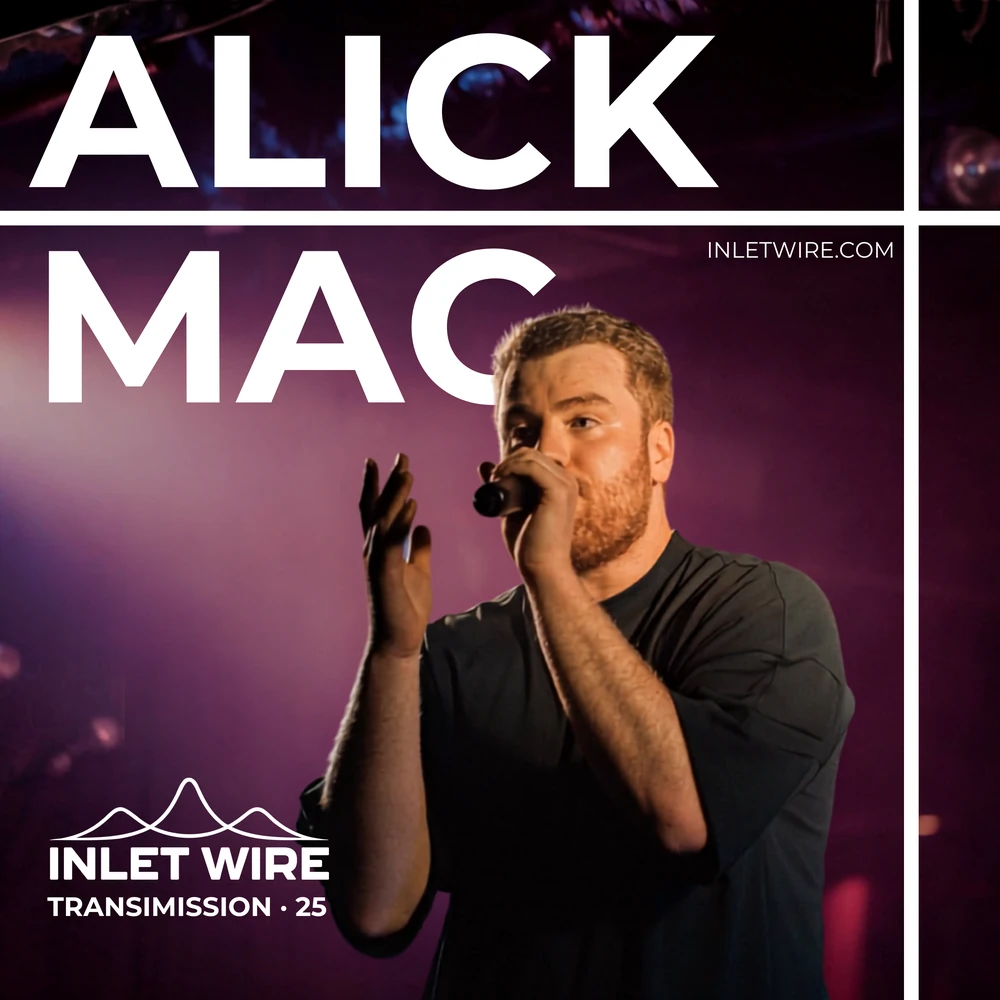
Alick Mac talks about songwriting like a journal.
For the Comox Valley rapper, singer and songwriter, that means starting with his own experiences and using music to make sense of things that can be difficult to put into words. It is a simple idea, but it explains a lot about where his work goes — from the way he writes songs to the larger questions behind his one-man show, Boys’ Club.
Music was there before any of that had a clear direction. Alick sang in choir when he was young, but it was later, in his teenage years, that hip-hop started to connect. He was drawn to the writing as much as the sound. English and writing had always come more naturally to him at school, and hip-hop gave that instinct somewhere new to go.
That relationship with writing is still at the centre of the process, but Alick does not treat every session like it has to produce a finished song. Sometimes a beat immediately gives him an energy or an idea. Other times, the value is simply in writing and keeping the habit alive.
That matters because, for Alick, songwriting also involves trust.
He talks about how even taking a short break from writing can make him second-guess a line or wonder whether he is expressing something the right way. Repetition helps rebuild that confidence. The songs that stay with him often arrive after long stretches of writing, not necessarily on the first day inspiration shows up.
Collaboration adds another variable. Sometimes Alick works closely with a producer from the beginning, talking through production choices and the qualities he wants a track to have. Other times, the starting point can be as simple as finding a beat online. He still sees himself in an exploratory stage, learning what he wants his sound to be and who he wants to become as an artist.
You can hear some of that range in “Toothpaste.”
Alick sees the song as one of the better examples of what he does because it brings his rapping and singing together. The song starts from a gloomy place — one of those days when things are not quite going right — but finds something hopeful in creativity itself.
Then there is “Easier to Shout.”
That song came from a much more exposed place. Alick describes it as an early release that helped establish how openly he wanted to write: pulling directly from his own experience and trying to be as emotionally honest as possible.
It also pushed him toward a bigger question.
Around the time he wrote the song, Alick had started thinking more closely about masculinity and some of the expectations men absorb around emotional control: staying stoic, not crying, and shutting down when feelings become overwhelming. Reading Liz Plank’s For the Love of Men helped him recognize some of those patterns in his own behaviour.
He wanted to put that realization into a song partly because it was not a conversation he felt he was having with many other men.
Eventually, that conversation became bigger than one song.
Boys’ Club is Alick’s one-man show built around masculinity, mental health and misogyny. It combines original songs with personal stories, reflections, and material drawn from his reading around masculinity and online spaces affecting young men and boys.
The show also pushed him into a different kind of performance.
Alick originally entered the Fringe world with the mindset of a musician looking for places to perform. Once he started thinking about what a theatre setting could offer, the idea became an artistic challenge. He began connecting songs with spoken sections, shaping the spaces between them, and thinking about how one part of the show could lead into the next.
That structure has continued to change as he performs and rewrites it.
But the point is not to hand the audience a simple answer.
Alick says he would rather leave someone questioning something small in their own life: why it can feel uncomfortable when a male friend opens up, or why crying in front of another person can feel so difficult. If the show can plant that kind of seed, that is enough.
For an artist whose songwriting began as a way of understanding his own experiences, Boys’ Club feels like a natural extension of the same process — only now the questions are being shared with a room.
The full conversation is on Inlet Wire.
Boys’ Club — Vancouver Fringe
Tickets and details → Website
 Instagram
 Bandcamp


 Facebook
More like this

Anna Katarina
Anna Katarina talks about her album While I Was Dreaming — a record built around the moments that happen outside the fantasy of success. We get into the pressure of releasing music now, what collaboration taught her about finishing a song, and why she came back to BC after time in Nashville.

Francis Baptiste
On this episode of Inlet Wire, Francis Baptiste talks about coming back to music, and how that path led him back toward language, family, and heritage. He talks about learning the Okanagan language, carrying parts of it into song, and why that matters to him as a father, songwriter, and member of a lineage he wants to help preserve. Francis also shares how he works with Levi Bent to shape poems into songs, and why one song, Snəqsilx (sneh-silk), has stayed close through it all.

Leah Abramson
Leah Abramson returns with new music under The Abramson Singers name. In this conversation, she talks about what changed in the years between releases, how these songs slowly came together, and why songwriting still matters to her now. We get into life between records, writing on piano instead of guitar, the a cappella thread that still runs through the project, and the meaning behind “Can You See It Now” from the new EP Anything You Could’ve Been.